Obsidian plugin · 4.14.0
General Settings
These settings control the foundational aspects of the plugin, such as task identification, file storage, and click behavior.
These settings control the foundational aspects of the plugin, such as task identification, file storage, and click behavior.
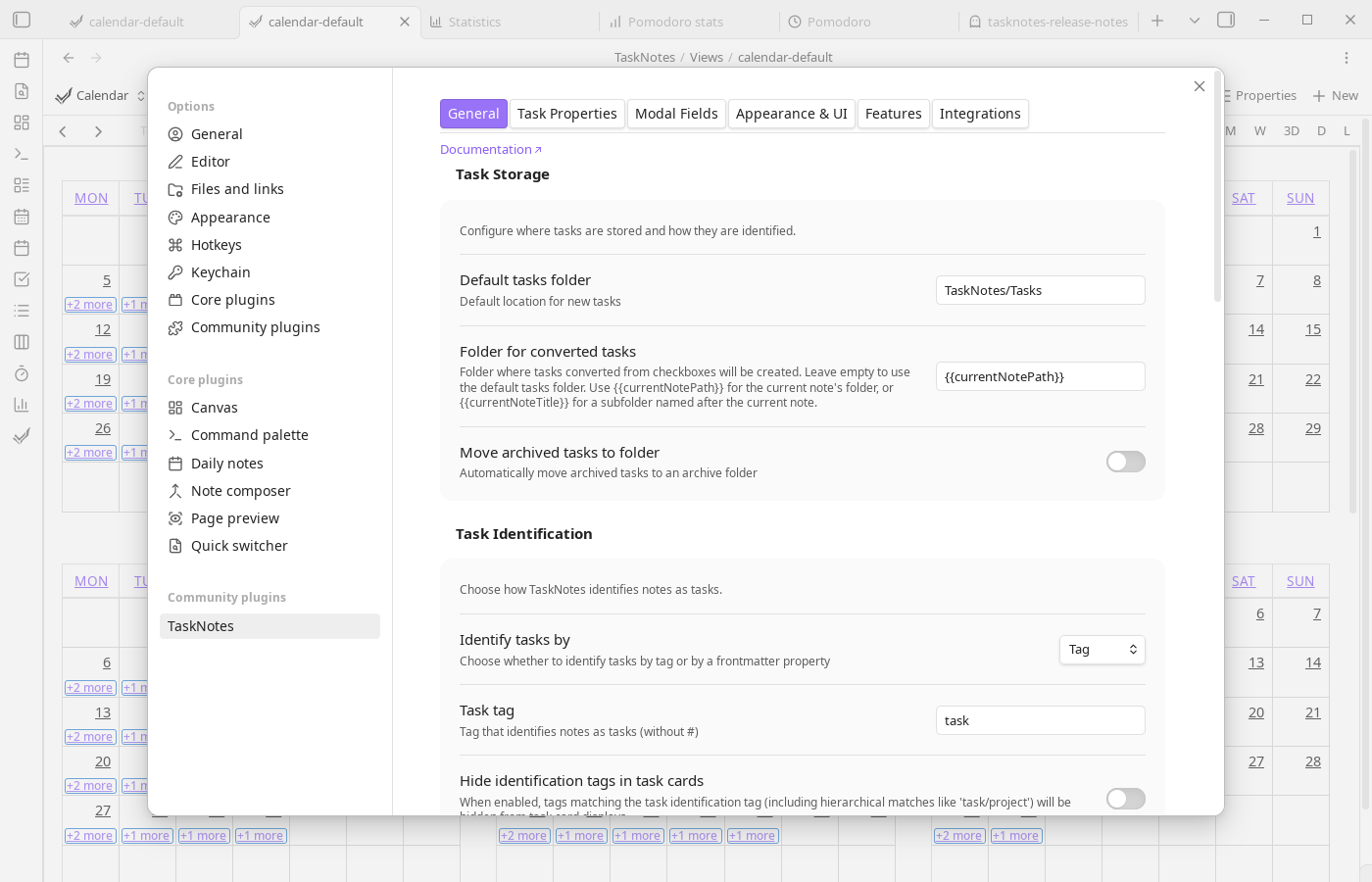
Task Storage#
Task storage settings define where new and inline-created task files are created and how archived tasks are relocated. Default tasks folder sets the base location and supports folder template variables, including {{currentNotePath}} and {{currentNoteTitle}} for creating command-palette or ribbon tasks beside the active note. It also supports date variables such as {{year}} and Daily Notes-style date tokens such as YYYY/MM/DD. Folder for inline-created tasks controls the Create Inline Task command and instant conversion output. Leave it empty to use the default tasks folder, set a fixed folder path to centralize inline tasks, or use {{currentNotePath}} and {{currentNoteTitle}} placeholders for contextual routing. Relative path segments such as ../ are normalized after variables are expanded. If archive moves are enabled, completed archived tasks are moved automatically to your configured archive folder.
Task Identification#
TaskNotes can identify task notes using either a tag or a frontmatter property.
Use Identify tasks by to select a strategy.
- Tag mode uses a configured task tag (for example
task) and can optionally hide that identifying tag in card displays. - Property mode matches a property/value pair (for example
isTask: trueorcategory: task) and is useful when you avoid tag-based identification.
If you change the task tag after creating default Base views, existing .base filters will still point at the old tag until you update the default Base files or edit those filters.
Hide Identification Tags#
When using tag-based identification, you may want to keep your task identification tags in the frontmatter for organizational purposes, but hide them from the visual display in task cards to reduce clutter.
The Hide identification tags in task cards setting allows you to do this. When enabled:
- Tags that exactly match your task identification tag (e.g.,
#task) will be hidden - Hierarchical child tags (e.g.,
#task/project,#task/work/urgent) will also be hidden - Other tags that don't match the identification pattern will still be displayed
- The setting only affects the visual display—tags remain in the frontmatter
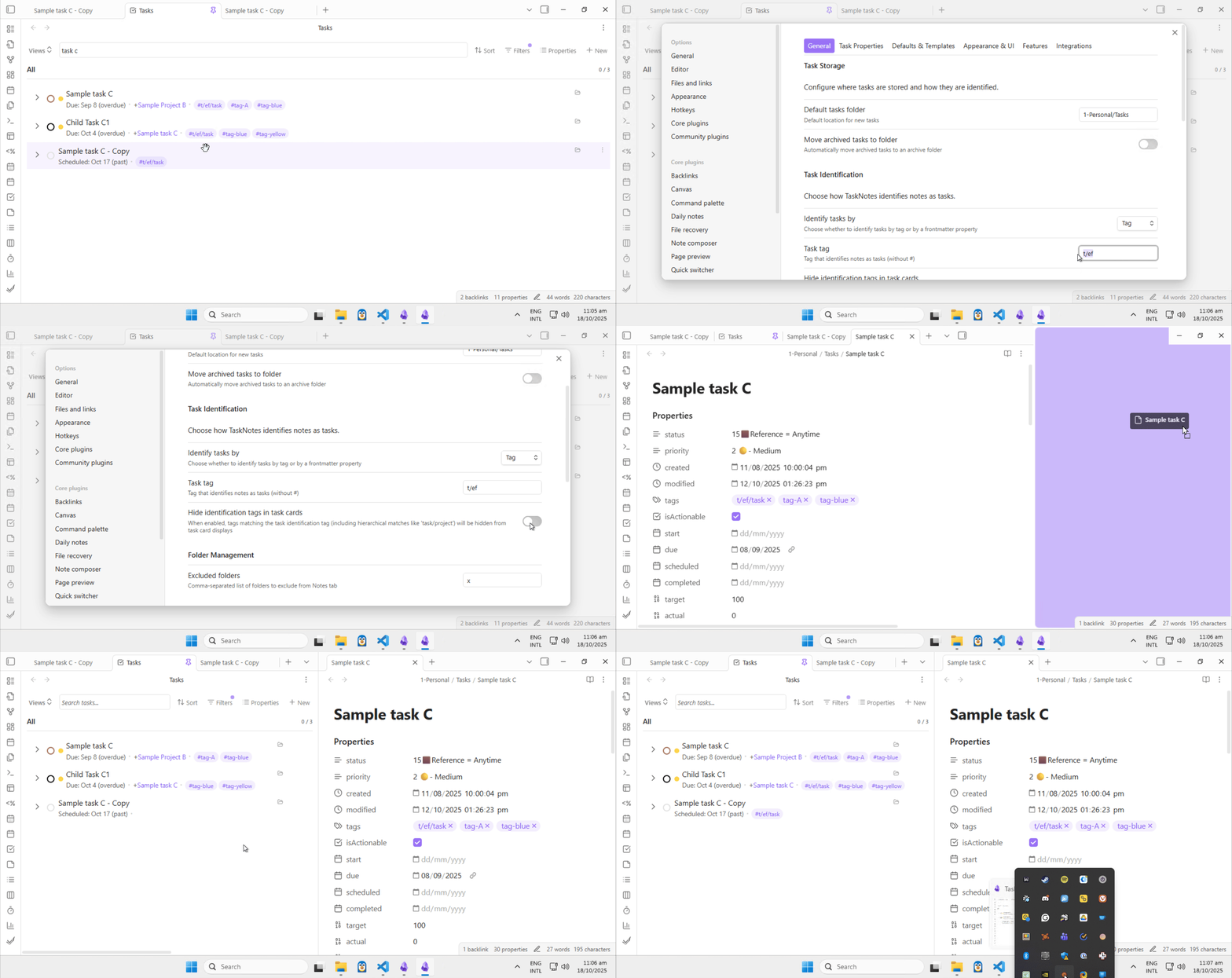
Example:
If your task identification tag is task and a task has the tags #task, #task/project, #important, and #review:
- With the setting disabled (default): All tags are shown:
#task,#task/project,#important,#review - With the setting enabled: Only non-identifying tags are shown:
#important,#review
Folder Management#
Use Excluded folders to omit paths from Notes tab indexing and keep large archive areas out of regular task browsing.
Views & Base Files#
TaskNotes uses Obsidian Bases files (.base) to power its task views. By default, missing view files are created automatically on startup.
Use Create files to generate missing default files in TaskNotes/Views/ without overwriting existing files. Use Update files to overwrite the configured default files with templates generated from your current TaskNotes settings.
Frontmatter#
This section only appears when you have markdown links enabled globally in Obsidian settings.
Use markdown links in frontmatter switches project/dependency serialization from wikilinks ([[path]]) to markdown links ([text](path)). This requires the obsidian-frontmatter-markdown-links plugin.
Task Interaction#
Task interaction settings define default click behavior on task cards. You can independently choose single-click and double-click actions (edit task, open note, or no action for double click).
Release Notes#
View release notes opens the release notes view for the current version. Notes also open automatically after updates and remain available from the command palette.