Obsidian plugin · 4.13.10
Task Properties Settings
This tab configures all task properties. Each property is displayed as a card containing its configuration options.
This tab configures all task properties. Each property is displayed as a card containing its configuration options.
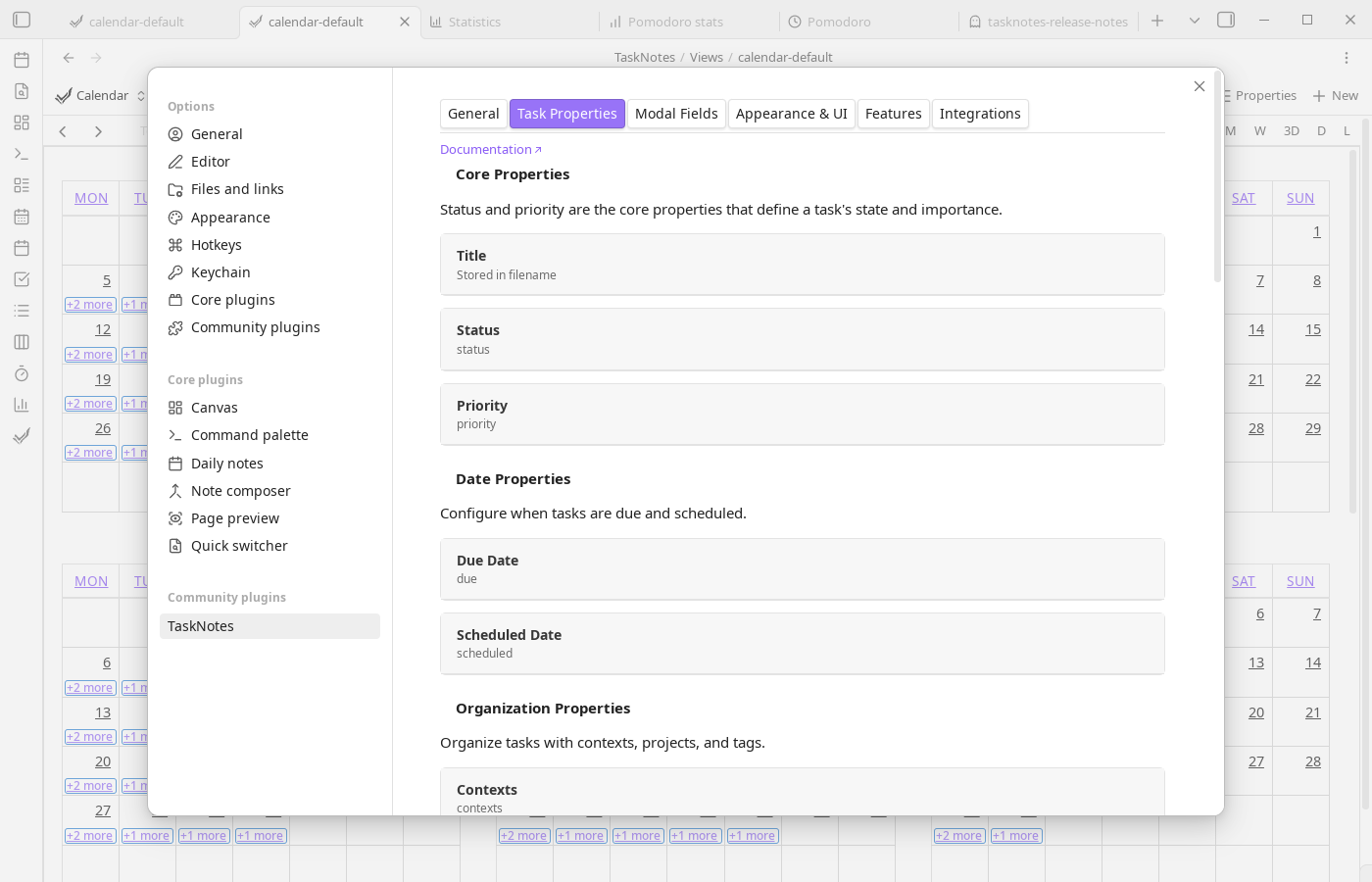
Property Card Structure#
Each property card contains:
- Property key: The frontmatter field name used to store this property
- Default: The default value applied to new tasks (where applicable)
- NLP trigger: Toggle and character configuration for natural language parsing (where applicable)
- Property-specific settings: Additional configuration options specific to that property This tab defines the task schema used by creation flows, NLP parsing, views, and API payloads.
Property keys are YAML/frontmatter keys. TaskNotes can read and write keys that contain spaces or punctuation, but hand-written Bases filters and formulas must reference those keys with bracket syntax, for example note["TN-status"], rather than dot syntax such as note.TN-status.
Core Properties#
Title#
The task title property. Configuration options:
- Property key: Frontmatter field name (default:
title) - Store title in filename: When enabled, the task title is stored in the filename instead of frontmatter. The filename updates when the title changes.
- Filename format: When "Store title in filename" is disabled, choose how filenames are generated:
- Title-based
- Zettelkasten-style
- Timestamp-based
- UUID v4
- Custom template
- Custom template: Define a custom filename pattern using variables (shown when "custom" format is selected)
Status#
Task completion state. Configuration options:
- Property key: Frontmatter field name (default:
status) - Default: Default status for new tasks
- NLP trigger: Character that triggers status parsing (default:
*) - Status Values: Expandable section containing individual status cards
Each status value has:
- Value: Internal identifier stored in frontmatter (e.g., "in-progress")
- Label: Display name shown in the interface (e.g., "In Progress")
- Color: Visual indicator color
- Icon: Optional icon identifier
- Completed: Whether this status represents a finished task
- Skip when cycling: Exclude this status from the click-to-cycle order on task cards while keeping it available in menus, suggestions, and direct edits
- Next status: Optional override for the status used when cycling forward from this status; leave it set to the status order to use the normal sequence
- Auto-archive: Automatically archive tasks after a delay (1-1440 minutes)
Status cards support drag-and-drop reordering.
Use the Value field as the stable stored identifier and the Label field for display text with spaces or title casing. TaskNotes status menus and cycling use the configured order, and TaskNotes Kanban views can preserve dragged column order. Native Bases grouping/sorting may still order status values alphabetically by their stored Value, so use prefixes such as 1-open, 2-doing, 3-done if you need predictable native Bases order.
Boolean Status Values#
TaskNotes supports using boolean values (true and false) as status values, which integrates with Obsidian's native checkbox property format:
- When you set a task's status to
"true"or"false"(case-insensitive), TaskNotes automatically converts it to a boolean in frontmatter - When reading tasks with boolean status values from frontmatter, they are converted back to the strings
"true"or"false" - This allows you to use Obsidian's native checkbox property toggles in the Properties panel while maintaining compatibility with TaskNotes
Example:
---
status: true    # Boolean checkbox in Obsidian
---
Priority#
Task priority level. Configuration options:
- Property key: Frontmatter field name (default:
priority) - Default: Default priority for new tasks (can be set to "No default")
- NLP trigger: Character that triggers priority parsing (default:
!, disabled by default) - Priority Values: Expandable section containing individual priority cards
Each priority value has:
- Value: Internal identifier stored in frontmatter (e.g., "high")
- Label: Display name shown in the interface (e.g., "High Priority")
- Color: Visual indicator color
Priority cards support drag-and-drop reordering. Status and priority values are stored in frontmatter; renaming them later may require migration of existing task files.
Note for Bases plugin users: Obsidian's Bases plugin sorts priorities alphabetically by their Value. To control sort order, name values to sort alphabetically in the desired order:
- Example:
1-urgent,2-high,3-medium,4-normal,5-low- Or:
a-urgent,b-high,c-medium,d-normal,e-low
Date Properties#
Due Date#
When the task must be completed. Configuration options:
- Property key: Frontmatter field name (default:
due) - Default: Default due date for new tasks (None, Today, Tomorrow, Next Week)
Scheduled Date#
When to work on the task. Configuration options:
- Property key: Frontmatter field name (default:
scheduled) - Default: Default scheduled date for new tasks (None, Today, Tomorrow, Next Week)
When you use Convert current note to task, this default is also applied if the source note does not already have scheduled frontmatter. Choose None to keep converted notes unscheduled by default.
due tracks commitment deadlines, while scheduled tracks intended execution time.
Organization Properties#
Contexts#
Where or how the task can be done. Configuration options:
- Property key: Frontmatter field name (default:
contexts) - Default: Comma-separated list of default contexts (e.g., @home, @work)
- NLP trigger: Character that triggers context parsing (default:
@)
Projects#
Projects the task belongs to. Configuration options:
- Property key: Frontmatter field name (default:
projects) - Default projects: Select project notes to automatically link to new tasks
- Use active note for new tasks: Automatically link the active note as a project when opening task creation from the command palette or ribbon
- Use parent note for inline/instant conversion: Automatically link the source note as a project when using inline task creation or instant task conversion
- NLP trigger: Character that triggers project parsing (default:
+) - Autosuggest Filters: Expandable section to filter which notes appear in project suggestions
- Customize Display: Expandable section to configure how project suggestions appear
Autosuggest Filters#
Control which notes appear when selecting projects:
- Required tags: Comma-separated list of tags (shows notes with ANY of these tags)
- Include folders: Comma-separated list of folder paths (shows notes in ANY of these folders)
- Required property key: Frontmatter property that must exist
- Required property value: Expected value for the property (optional) These filters reduce suggestion noise in large vaults.
A "Filters On" badge appears when any filters are configured.
Customize Display#
Configure project suggestion appearance:
- Enable fuzzy matching: Allow typos and partial matches in project search
- Row 1, 2, 3: Configure up to 3 lines of information for each project suggestion
Tags#
Obsidian tags for categorization. Configuration options:
- Default: Comma-separated list of default tags (without #)
- NLP trigger: Character that triggers tag parsing (default:
#)
Note: Tags use native Obsidian tags and do not have a separate property key setting.
Task Details#
Time Estimate#
Estimated time to complete the task. Configuration options:
- Property key: Frontmatter field name (default:
timeEstimate) - Default: Default time estimate in minutes (0 = no default)
Recurrence#
Pattern for repeating tasks. Configuration options:
- Property key: Frontmatter field name (default:
recurrence) - Default: Default recurrence pattern (None, Daily, Weekly, Monthly, Yearly)
Recurring tasks also use the Recurrence anchor metadata property to decide whether the series advances from the scheduled date or the completion date. Materialized occurrence note controls live on each recurring task's context menu under Recurrence → Occurrence notes rather than as a global default.
Reminders#
Notifications before task deadlines. Configuration options:
- Property key: Frontmatter field name (default:
reminders) - Default Reminders: Expandable section containing default reminder cards
Each default reminder can be:
Relative reminders (triggered relative to due or scheduled date):
- Anchor date (due date or scheduled date)
- Offset amount and unit (minutes, hours, days)
- Direction (before or after)
- Description
Absolute reminders (triggered at specific times):
- Date
- Time
- Description
Metadata Properties#
These properties are system-managed and typically only require property key configuration:
- Date Created: When the task was created
- Date Modified: When the task was last modified
- Completed Date: When the task was completed
- Archive Tag: Tag used to mark archived tasks
- Time Entries: Time tracking entries for the task
- Complete Instances: Completion history for recurring tasks
- Skipped Instances: Skip history for recurring tasks
- Recurrence Anchor: Whether recurring progression is based on scheduled date or completion date
- Blocked By: Tasks that must be completed first
Materialized occurrence notes also use system-managed frontmatter fields such as recurrence_parent, occurrence_date, occurrence_materialization, occurrence_next_trigger, and optional occurrence template/horizon fields. Occurrence notes inherit parent planning metadata when they are created, but keep their own status, completion date, and time entries. These fields are documented in the Property Types Reference and are normally changed through recurrence and occurrence-note controls instead of by hand.
Feature Properties#
These properties are used by specific TaskNotes features and are not stored in task frontmatter:
- Pomodoros: Property key for Pomodoro session counts. When Pomodoro data storage is set to "Daily notes", this property is written to daily notes rather than task files.
- ICS Event ID: Property key for calendar event identifiers. Added to notes created from ICS calendar events to link them back to the source event.
- ICS Event Tag: Property key for calendar event tags. Added to notes created from ICS calendar events for identification.
Custom User Fields#
Define custom frontmatter properties to appear as filter options across views. Configuration options for each field:
- Display Name: How the field appears in the UI
- Property Key: The frontmatter property name
- Type: Data type (text, number, boolean, date, or list)
- Default Value: Pre-fill value for new tasks (format varies by type)
- NLP trigger: Toggle and character for natural language parsing
- Autosuggest Filters: Filter which files appear when using
[[wikilink autocomplete Custom fields are most maintainable when they map to repeated workflow decisions (for exampleeffort,owner, orclient).
Link Values#
Use a Text custom field for a single link and a List custom field for multiple links. Task cards render [[wikilinks]], [label](https://example.com), <https://example.com>, and bare https://example.com values as clickable links.
Autosuggest filters work with text and list fields when entering [[ wikilinks, so a field such as Related Note can suggest only files from a chosen folder or tag.
Default Values#
Each field type has a different input format for default values:
- Text: Enter the default text value
- Number: Enter the default number
- Boolean: Toggle switch to set default checked/unchecked state
- Date: Select from presets (None, Today, Tomorrow, Next Week)
- List: Enter comma-separated default values
Default values are applied when creating tasks via:
- Task creation modal
- Instant task conversion
- "Create or open task" command
- HTTP API (when using task creation defaults)
Autosuggestion Filters#
Each custom field can configure filters to control which files appear in wikilink suggestions:
- Required tags: Comma-separated list of tags (shows files with ANY of these tags)
- Include folders: Comma-separated list of folder paths (shows files in ANY of these folders)
- Required property key: Frontmatter property that must exist
- Required property value: Expected value for the property (optional)
A "Filters On" badge appears when filters are configured.
See User Fields Feature Documentation for detailed examples.